
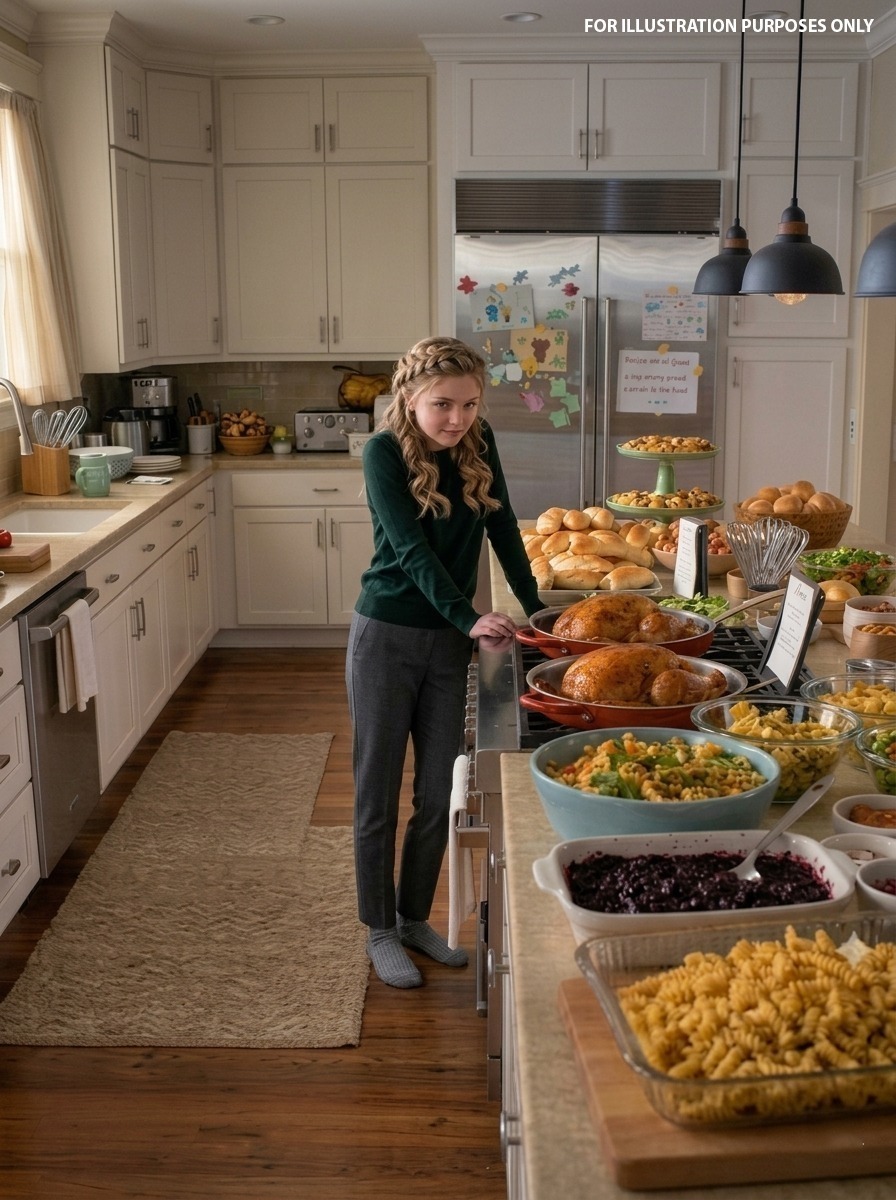
The moment everything changed did not feel dramatic.
There was no raised voice, no obvious conflict, no clear beginning to the shift that would later divide our family into before and after. Instead, it arrived quietly, almost gently, in a way that made it easy to miss—until it was too late to pretend it hadn’t happened.
And like most things that matter, it began with love.
My daughter Emily has never been the kind of person who asks for attention.
She moves through the world softly, observing more than she speaks, choosing her moments carefully, and when she wants to express something that feels too big for words, she cooks. Not casually, not as a hobby, but with intention, as if every ingredient carries meaning and every dish is a way of saying something she doesn’t know how to say out loud.
Cooking is how she loves people.
When my mother’s seventieth birthday was approaching, Emily came to me with an idea that she presented so calmly it almost sounded simple. She wanted to cook the entire dinner herself, not just contribute a dish or help with preparation, but take responsibility for everything, from the main course to the smallest detail.
Dinner for twenty-three people.
At first, I thought she didn’t understand what she was offering, the scale of it, the exhaustion it would require, and I told her as much. I suggested she choose something smaller, something manageable, something that wouldn’t demand so much of her.
She listened.
Then she smiled in that quiet way of hers and said, “I just want Grandma to feel special.”
That was the moment I should have understood.
This wasn’t about the food.
It was about being seen.
She started on Wednesday.
By Thursday morning, the kitchen had already transformed into something else entirely, no longer a space for daily routines, but a place of focus and creation. Ingredients were measured and remeasured, recipes carefully written out and taped to cabinets, pots simmering slowly as the house filled with warmth and familiar scents that seemed to carry memory as much as flavor.
Emily moved through it all with a steady rhythm, not rushed, not overwhelmed, but deeply present, as if she had already committed herself fully to what she was building.
She didn’t complain.
She didn’t stop.
Even when I told her to rest, she shook her head gently and said she was fine, and in a way, she was. Tired, yes, but anchored by something stronger than exhaustion.
Pride.
Purpose.
Hope.
By Saturday afternoon, everything was ready.
The food was laid out in careful order, each dish placed with intention, as if the arrangement itself mattered, as if it was part of the message she was trying to deliver. The house smelled like celebration, like something warm and generous waiting to be shared.
The dinner was set for six.
At 4:12 p.m., my phone buzzed.
It was a message from my father.
“We’ve decided to celebrate at a restaurant instead. Adults only.”
I read it once.
Then again.
The words didn’t change.
They didn’t soften.
They didn’t explain themselves.
They simply existed, final and complete, as if the decision had never needed to include us in the first place.
For illustrative purposes only
When I walked back into the kitchen, Emily was standing by the counter, brushing away crumbs, adjusting trays, humming quietly to herself in a way that made the moment feel almost fragile, like something that could break if touched too abruptly.
I didn’t know how to tell her.
Continued on next page:
There is no gentle way to deliver something like that.
“Sweetheart,” I said finally, my voice slower than usual, “plans changed.”
She turned, confusion crossing her face, and when I handed her the phone, she read the message carefully, not rushing, not reacting immediately, just absorbing it in a way that felt far too mature for her age.
Her shoulders lowered slightly.
Her hands stilled.
She looked at the food.
Then back at me.
“Why would they do that?” she asked.
It wasn’t anger.
It wasn’t even sadness.
It was something quieter.
Something that asked a question no one had answered for her before.
I pulled her into a hug, holding her longer than usual, because in that moment, I understood something I hadn’t allowed myself to fully see until then.
“They didn’t see it,” I said. “But we do.”
The decision I made next didn’t come from logic.
It came from something deeper.
Something protective.
Something final.
That evening, instead of waiting for people who had chosen not to come, I opened our local community page and wrote a simple message, offering the meal to anyone who needed it, without conditions, without explanation, just an invitation for the food to be used for what it had been meant for all along.
To care.
People came.
Slowly at first, then steadily, each arrival carrying a different kind of hesitation, gratitude, or quiet relief. Some avoided eye contact, some spoke too much, some said nothing at all, but every plate Emily handed out shifted something inside her.
I could see it.
With each thank you, each smile, each moment of recognition, something that had been overlooked earlier began to take shape again.
Not as validation.
But as understanding.
By the end of the night, the food was gone.
But nothing felt wasted.
The next morning, the consequences arrived.
Not quietly.
Not gently.
My parents stood at the door, their anger already formed before a single word was spoken, and when they stepped inside, it wasn’t to understand, it was to correct, to control the narrative, to shift the focus away from what had happened and onto how it had made them look.
“What were you thinking?” my mother demanded.
I didn’t raise my voice.
I didn’t need to.
“Emily cooked for three days,” I said.
That was the moment everything sharpened.
Not because of what I said.
But because of what came next.
“She’s a child,” my mother replied. “She’ll get over it.”
The words didn’t echo.
They landed.
And something inside me settled in a way it never had before.
“She’s your granddaughter,” I said, my voice steady. “And she deserved to matter in this.”
Emily stood there, silent, absorbing everything, but this time she wasn’t shrinking.
She was learning.
That was when I understood what this moment really was.
Not a misunderstanding.
Not a mistake.
But a boundary.
“You’re not welcome here,” I said finally, not loudly, not dramatically, but with a certainty that didn’t leave space for negotiation, “until you understand what respect looks like.”
After they left, the house felt different.
NEXT PAGE
ADVERTISEMENT
