
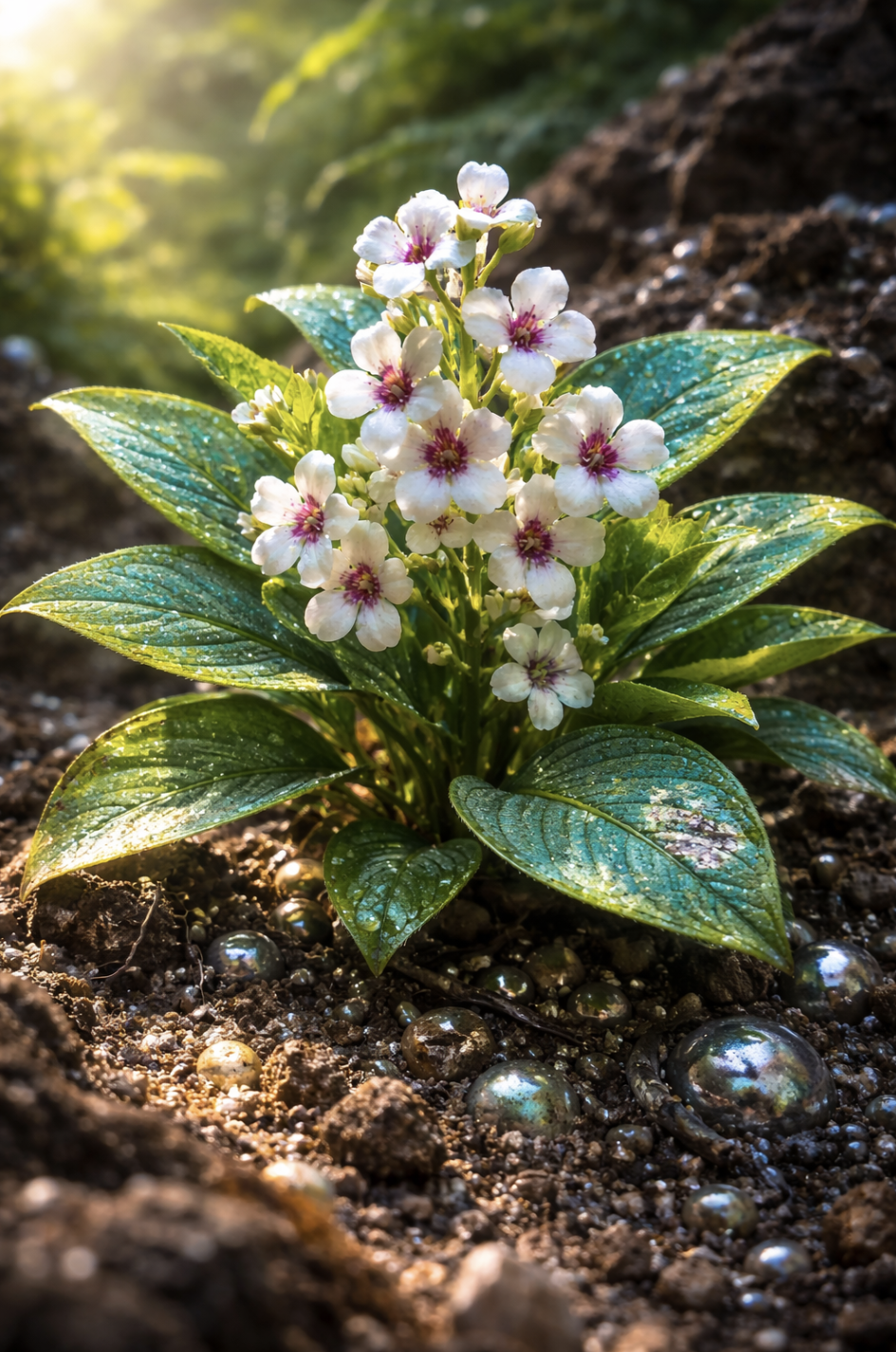
In the thick, trembling air of the Philippines’ tropical forests, something extraordinary grows, and not with vengeance or poison, but with purpose.
This plant doesn’t bloom to be admired, although I admire it just the same, and it doesn’t wilt in shame. No, it consumes metal.
Its roots curl through the earth like quiet scientists, testing and tasting. Not for nutrients or for water like normal plants (my tomato plants in my hydroponic system are currently looking at me as I type this), but for nickel, zinc, cobalt, and oddly enough, pollutants.
This is Rinorea niccolifera: a rare plant with an appetite for heavy metals and the power to rewrite what we thought plants could even do on this planet.
It doesn’t just survive pollution, it thrives in it.
Discovery in the Dirt
In 2014, scientists in the Philippines made an astonishing find on Luzon Island, where mining scars the landscape and the soil brims with toxic leftovers. Nestled in this harsh terrain, Rinorea niccolifera was found quietly absorbing up to 18,000 ppm of nickel. For the record, that’s 1,000 times more than most plants can handle without dying.
They didn’t engineer this miracle or splice genes or run simulations, no they simply looked closely enough at what nature was already doing, and realized it had been working on this trick for millennia.
Rinorea niccolifera belongs to a remarkable, tiny family of plants called hyperaccumulators: species that can absorb toxic heavy metals from the soil and store them in their tissues.
There are only about 700 known hyperaccumulator species on Earth (I say “only” lightly), and most people have never heard of them. I bet you haven’t heard of more than one or two of them. No one takes much note of them because they do their work slowly with no drama or spectacle.
Make no mistake though, they’re the quiet cleanup crew of our planet, helping to right a lot of our wrongs.
Here are just a few other notable hyperaccumulators:
Alyssum murale – Absorbs nickel and is used in European phytomining trials.
Thlaspi caerulescens – A model plant for zinc and cadmium studies.
Pteris vittata – A fern that accumulates arsenic.
Berkheya coddii – Native to South Africa, known for nickel uptake.
Haumaniastrum robertii – Found in the Congo, tolerates cobalt reasonably well.
These plants don’t just detoxify land either, they teach us something profound: that healing and extracting aren’t always opposites, sometimes, they’re the same thing.
ADVERTISEMENT
