
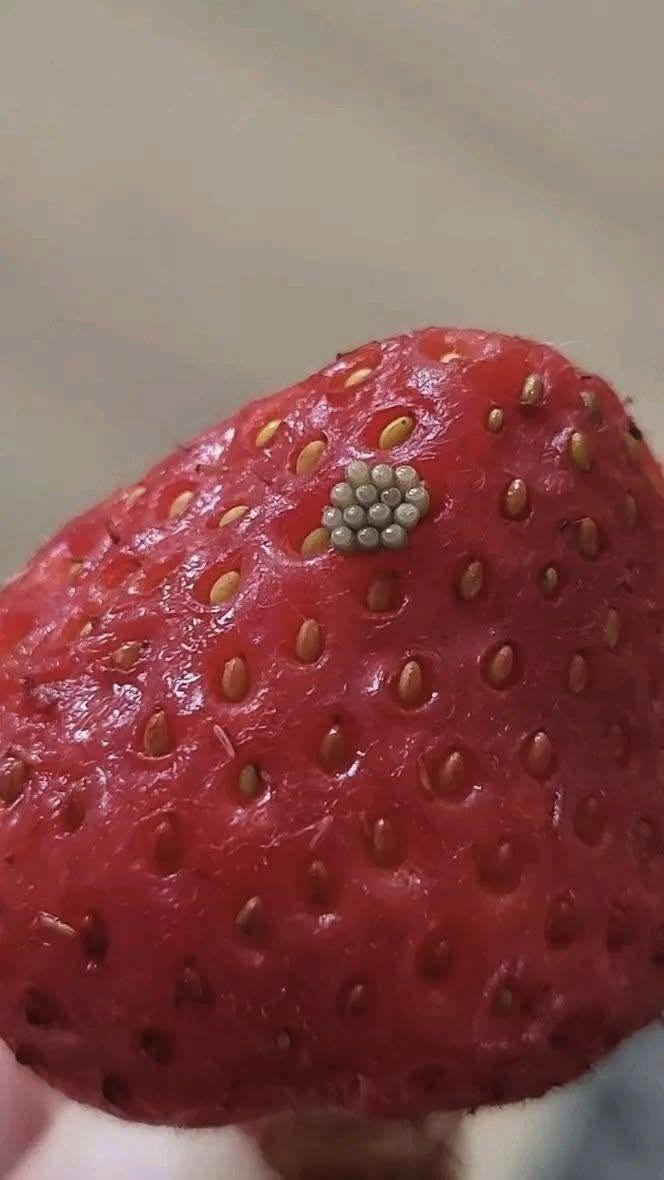
Why You’ve Probably Already Eaten Insect Larvae (Without Knowing It)
Let me normalize this for you.
The FDA allows certain levels of “insect fragments” and “maggots” in food. It’s impossible to grow food outdoors without some insect contamination.
FDA allowances:
Canned or frozen peaches: Up to 3% of fruit may have insect damage (including larvae).
Canned fruit juice: Up to 1 maggot per 250ml.
Chocolate: Up to 60 insect fragments per 100g.
Peanut butter: Up to 30 insect fragments per 100g.
Wheat flour: Up to 75 insect fragments per 50g.
You’ve eaten insect parts. You’ve eaten insect larvae. You’re fine. Your body doesn’t know the difference.
The Bigger Picture (Why This Matters)
The spotted wing drosophila is a serious agricultural pest. It causes millions of dollars in damage each year by making fruit unmarketable (not unsafe, just cosmetically unappealing).
What farmers are doing:
Monitoring traps to detect fruit fly presence
Sanitation (removing infested fruit from fields)
Insecticides (conventional farms)
Biological control (introducing natural predators)
Resistant varieties (breeding fruit that are less attractive to the fly)
What consumers can do:
Don’t panic. This is a natural part of growing food outdoors.
Support integrated pest management (IPM) practices that reduce pesticide use while managing pests.
Wash your fruit (which you should do anyway for bacteria and pesticide residues).
Frequently Asked Questions
Can eating these larvae make me sick?
No. They are not parasitic, toxic, or disease-carrying.
I already ate some berries without soaking them. Should I worry?
No. You’ve almost certainly eaten fruit fly larvae before without knowing it.
Do organic strawberries have more larvae?
Yes, typically. Organic farms don’t use synthetic pesticides, so insect pressure is higher. But many consumers prefer organic for environmental and health reasons.
Can I see the larvae with the naked eye?
Yes, if you look closely. They’re tiny (2-3mm) but visible.
Do frozen berries have larvae?
Possibly. Freezing kills the larvae, so they won’t be alive. But they may still be present.
Should I stop eating strawberries?
No. Strawberries are healthy and delicious. The risk is negligible.
What’s the best way to avoid eating larvae?
Cook your berries. Heat kills larvae. If you eat them raw, accept that you may be consuming tiny amounts of insect protein.
A Reassuring Conclusion
Here’s what I want you to take away from this article.
Those tiny white worms are not a sign that your berries are “contaminated” or “unsafe.” They’re a sign that your berries were grown outdoors, in soil, in the real world.
Spotted wing drosophila larvae are not harmful. They’re not a food safety issue. They’re a cosmetic issue.
If the thought of eating them grosses you out, soak your berries in salt water or vinegar water. Or cook them. Or don’t. You’ve almost certainly eaten them before without knowing it, and you’re fine.
I still eat strawberries. I don’t soak them. I don’t worry. And I’ve never been sick.
You can do the same.
Now I’d love to hear from you. Have you tried the salt water soak? Did you see larvae? Did it ruin strawberries for you? Drop a comment below – I read every single one.
And if this article helped you stop worrying about your berries, please share it with a friend who’s been avoiding strawberries since seeing that viral video. A text, a link, a conversation. Good information is the best antidote to fear. 🍓🪱💧
ADVERTISEMENT
